


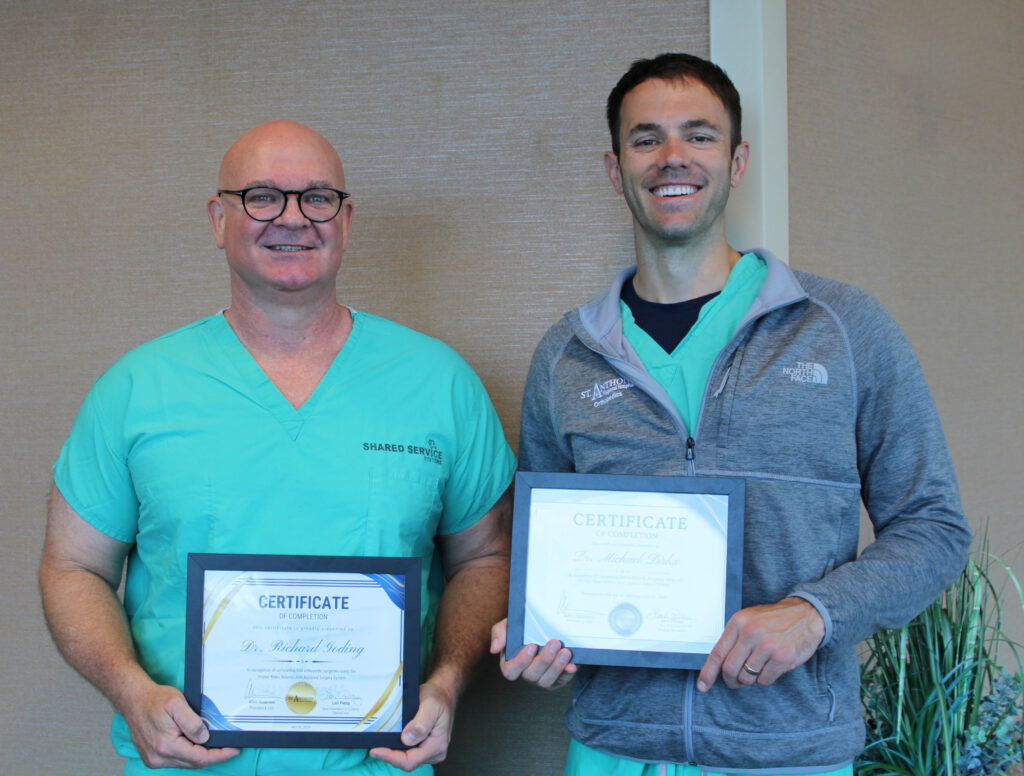
St. Anthony Regional Hospital has 1,000 more reasons to celebrate! Michael Dirkx, D.O., and Richard Goding, M.D., have each reached an incredible milestone in their medical careers. Dr. Dirkx recently performed his 500th surgery using the Stryker Mako robot, while Dr. Goding completed his 580th surgery. Together, the two have surpassed 1,000 robotic-assisted orthopedic procedures, strengthening access to advanced joint replacement surgery in the region.
“That’s a lot of joints in six years!” remarked Dr. Goding. “We were only the sixth hospital in the entire state to get this technology at the time. This milestone means we’re now an established center for Mako robotic joint replacements, and patients are comfortable getting excellent care from our team. For a rural hospital, that’s a pretty big deal, and it shows the level of confidence in our joint replacement program.”
First introduced to St. Anthony Regional Hospital in 2020, the technology is one of only a handful in the state. Today, Mako supports orthopedic procedures, specifically joint replacement surgeries such as total knee replacement, partial knee replacement and total hip replacement.
“It’s unique in rural Iowa to have such technology; it’s the gold standard for robotic hip and knee replacement — no other robot even comes close to it,” says Dr. Dirkx. “It’s better for patients. It allows us to do more complex cases and know that patients are going to have a better outcome. It’s nice to provide that to the community. Knowing we can do that locally really means a lot to us.”
Understanding the Technology
According to Stryker, the company behind the robotic-arm-assisted surgical system, the Mako Robot platform combines 3D CT-based planning with AccuStopÔ haptic technology designed to help optimize knee and hip implant positioning and enhance functional outcomes.
“There’s strong data that implants are placed more accurately with the robot,” says Dr. Dirkx. “Bone cuts are much more accurate than the traditional method, and the recovery time is better, too. Individuals can typically get back to normal activities after two weeks. With the traditional method, we see patients using walkers four to six weeks after surgery. There’s less swelling and improved range of motion with Mako-supported surgeries.”
Dr. Dirkx notes the technology helps reduce the risk of nerve and ligament damage, along with infection, leading to faster recovery and less downtime.
“The robot locks into certain boundaries and can’t cut outside those boundaries,” he says. “It can cut down to the half millimeter — no other robot can do that. This means there’s less pain after surgery, less blood loss and swelling.”
The Process Before the Procedure
The process for scheduling a surgical appointment using the Mako technology is fairly straightforward. Patients first schedule a routine appointment with St. Anthony Orthopedics, during which the physician evaluates the patient, performs clinical assessments and reviews X-rays. The physician then determines whether all nonoperative management strategies have been exhausted. If the patient is a good candidate for surgery, they discuss the associated risks and benefits.
“The benefits of robotic joint replacement are evident when it comes to patient satisfaction, and there are stats to prove it,” notes Dr. Goding. “For example, with standard knee replacement surgeries, 82% of patients surveyed were satisfied or very satisfied following their surgery. With the robotic-assisted technology, that number increases to 94% of patients being satisfied or very satisfied with their outcome.”
Once approved to move forward, the patient is provided with a comprehensive informational packet covering preoperative planning, preparation steps, home readiness and what to expect from the recovery process. Before surgery, the surgeon collaborates with a Stryker representative to plan the case, including specialized instrumentation needs and day-of-surgery protocols.
For patients who may have reservations about the technology, Dr. Dirkx emphasizes that the Mako system is always “robotic assisted,” meaning the surgeon remains in control throughout the procedure.
“I’m right by the robot — it’s not doing the surgery by itself,” says Dr. Dirkx. “It’s very, very safe. … I’m right there with them. It’s still my surgery; the robot just helps.”
Dr. Goding also stresses the safety and accuracy of the technology with patients who may be on the fence.
“The system operates using haptic guidance, which places the incisions exactly where you want them to go,” says Dr. Goding. “It prevents you from getting into veins or arteries. It protects you from going too far. It’s a very accurate and very safe technology. Because of that haptic guidance, it’s next to impossible to make mistakes.”
More Surgeons, More Surgeries, More Efficient care for St. Anthony Patients
Having two tenured surgeons well versed in these procedures is an incredible achievement for the hospital.
“Between the two of us, we’re over 1,000 Mako joint replacements,” says Dr. Dirkx. “We’re one of the top robotic surgical locations in the state.”
Over the years, confidence in the system has grown as more surgeries have been performed.
“I think, professionally, reaching this milestone means that you have honed your process, and that results in improved outcomes,” says Dr. Dirkx.
And like the professionals who operate it, the technology itself has become more refined over time.
“I tell patients that nonrobotic knee replacement is like driving a car from the 1960s — safety and performance are in completely different worlds,” says Dr. Goding. “Without the robot, we would still be performing surgeries much the same way we did 50 years ago, with only small, incremental improvements. With Mako, the system is constantly advancing through software upgrades that make the process better. The latest research is built into the robot’s framework, and updates have improved the applications, streamlined the workflow and increased accuracy.”
The Future of Mako Surgeries
The Mako surgical robot is continuously evolving, becoming more efficient and accurate with each system or model update.
“The functionality improves over time,” says Dr. Dirkx. “The robot updates just like a cell phone updates. Tech is always evolving, and continuous updates lead to smoother planning and more accuracy.”
Down the road, Dr. Dirkx looks forward to the next evolution for the system — shoulder surgeries.
“There’s a shoulder platform out for it now, so we hope to potentially do robotic shoulder placements in the future,” he adds.
As one of the leading robotic joint replacement centers in the state, St. Anthony remains committed to staying on the leading edge of surgical technology, ensuring patients receive the best care locally. We applaud Drs. Dirkx and Goding on reaching a combined 1,000-plus surgeries with Mako.
“With Mako, St. Anthony has invested in safer, more accurate joint replacements for every patient, without passing the cost of the technology on to them,” says Dr. Goding. “And I love working with Dr. Dirkx. Together, we combine the best parts of both an early- and late-career surgeon. I think this is a great milestone, and I hope we can do another 1,000 surgeries together.”
For those interested in learning more or scheduling a consultation with Dr. Dirkx or Dr. Goding, contact St. Anthony Orthopedics at 712-794-5536.
Citation:
Smith AF, Eccles CJ, Bhimani SJ, Denehy KM, Bhimani RB, Smith LS, Malkani AL. Improved Patient Satisfaction following Robotic-Assisted Total Knee Arthroplasty. J Knee Surg. 2021 Jun;34(7):730-738. doi: 10.1055/s-0039-1700837. Epub 2019 Nov 15. PMID: 31731324.